

What type of heat pump is right for your home?
Scroll down to see your options based on what type of system you currently have
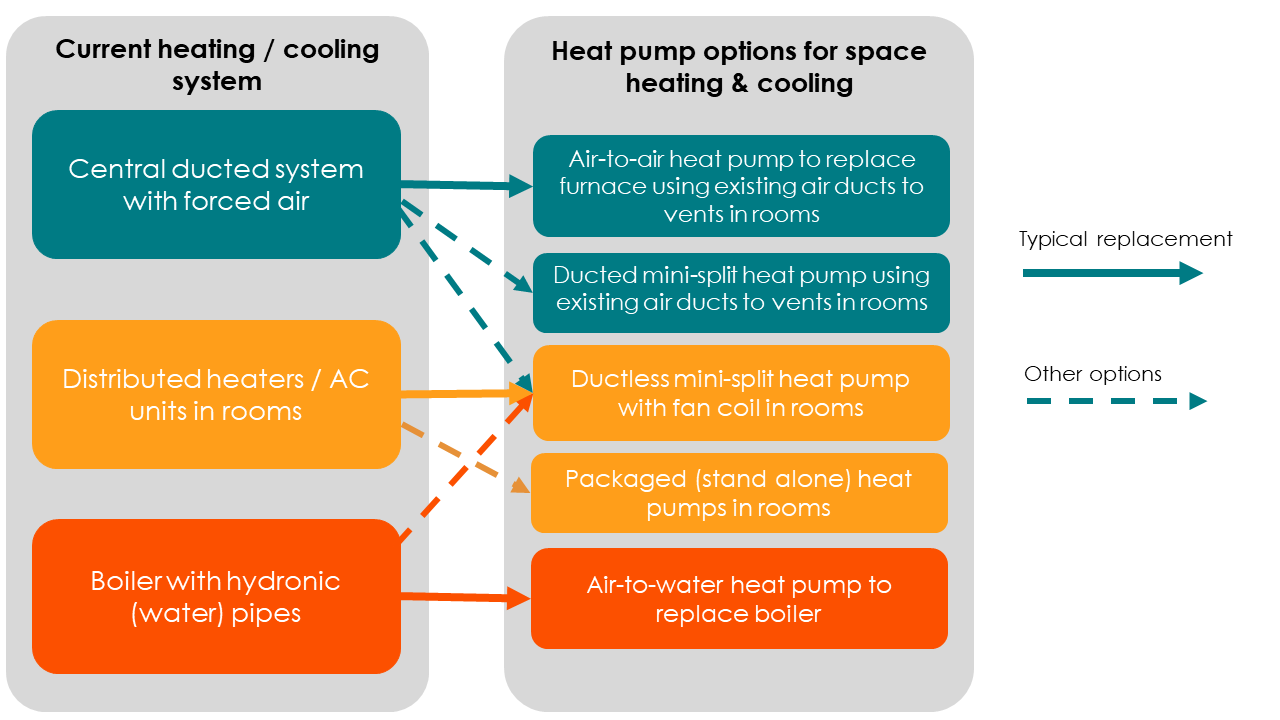
What is my current heating / cooling system?
-

Central ducted system with forced air
If you heat or cool your home with air coming out of vents on the floor or walls, that means you have a ducted system. Air ducts move hot air from your furnace to the rooms — or cool air when you use air conditioning. This is also known as central heat or central A/C. It is common for homes along the California coast to only have central heat but no central A/C. If you currently have a ducted system, it probably makes sense to stick with a ducted heat pump system — which replaces your furnace with a heat exchanger connected to the outside heat pump unit. Be sure to have your contractor inspect your ducts though - a lot of heat can be lost if insulation is poor!
-

Distributed heaters / AC units in rooms
If you are using separate heaters or A/C units in rooms throughout your home, it likely means you do not have ducts and vents. Common examples include space heaters, baseboard heaters, radiators, room or window A/C, evaporative (swamp) coolers, etc. In this case, it is usually simplest to replace these with a ductless heat pump system that uses thin tubes with refrigerant to distribute heat or cold to each room, since retrofitting a home with ducts can be very costly. These tubes connect to head units in each room with fan coils — small quiet fans that provide hot or cold air. In some cases, where you only want to heat or cool a few rooms, it may be simpler to install separate packaged heat pump units in those rooms. These units must be connected to the outside. They may be installed in a window, like a window air conditioner, or have two pipes that take air from the outside and return the exhaust air back outside.
-

Boiler with hydronic (water) pipes
A boiler heats water which is distributed by water pipes throughout your home to radiators, baseboard heaters, or in-floor radiant heating. This is also referred to as a hydronic system. If you have a boiler with hydronic pipes, it may make sense to simply replace your boiler with an air-to-water heat pump. That means your home will continue to use the existing radiators or baseboard heaters; the only thing that changes is the way that the water is heated. A heat pump also lets you distribute cold water in the summer to cool your house. Sometimes, you may need to replace your radiators or baseboards with fan coil units in each room to augment the distribution of heat or cold relative to the natural convection with radiators.
Heat pump options

Central ducted system with forced air
-
Central air-source heat pumps have two systems (one outdoor unit called the condenser, and an indoor air handler that typically sits in a basement or utility closet). These systems are connected with refrigerant lines and electrical wires. The air handler is what actually heats or cools the air which is then distributed throughout your home through ducts and vents. There are three types of central systems: variable speed, dual speed, and single speed heat pumps, which are described below.
Variable speed heat pumps have sophisticated computer systems that calculate real time differences in the indoor / outdoor temperatures which makes it incredibly efficient and also quiet. These are also known as having “inverter drives” or “variable refrigerant flow” heat pumps. Variable speed systems are quieter compared to single speed systems (55 to 76 decibels).
Dual speed (or two stage) heat pump systems has a compressor that works at two speeds (a high and low setting). This means you have two settings (rates) at which you heat or cool your home. The dual speed technology is less complex than a variable speed system, but is more sophisticated than a single speed (below) system. These systems are cheaper than variable speed systems, but less efficient.
Single speed systems are some of the most common ducted air source heat pumps in the United States. The benefits to central single speed systems is that they cost less and are very reliable, and if they do break they have fairly low repair costs. However, single speed air source heat pumps aren’t as efficient as a central variable speed heat pump, which means a higher monthly electricity bill. This is because they utilize a single-stage compressor which is either ON/OFF without any in-between. This means it is working at maximum power even in milder weather. They are also louder than a variable speed system (single speed systems typically operate at 72 to 76 decibels).

Ducted mini-split
-
Ducted mini-split systems consist of an exterior heating/cooling unit that sits outside and an interior horizontal ducted unit. The horizontal ducted unit typically sits inside of a ceiling, attic, basement, or mechanical room - somewhere out of sight but still accessible for maintenance. The horizontal ducted unit takes incoming air and heats or cools it, and then distributes that air through ducts and vents.
Ducted mini split heat pumps are some of the most efficient systems out there because the duct work is typically shorter, which is where most of the efficiency loss comes from in central systems.
These systems are very quiet and they have a small footprint - both the indoor air handler and the outdoor condenser units are smaller compared to a central ducted system.

Ductless mini-split
-
Ductless mini-split systems consist of an interior wall mounted fan coil and an exterior heating/cooling unit that sits outside (hence, split). The indoor and outdoor unit are connected with a small refrigerant loop that runs between them.
Ductless mini-split air source heat pumps use refrigerant pipes rather than air ducts to move heat around your home. Refrigerant is piped to a coil and a fan inside the ductless terminal unit blows air across it to heat/cool the air.
The benefit to ductless systems is that they are very efficient and they do not require existing central air ducts. If your home does not currently have air ducts and vents, a ductless mini-split is probably the most economical option because installing air ducts in a home is very costly. Ductless mini-splits are also usually the most affordable units on the market, especially for smaller homes.
You might have noticed in the diagram above that all three types of existing heating/cooling systems (central ducted with forced air, distributed heaters/AC in rooms, and boiler with hydronic) can be replaced with a ductless mini-split heat pump. Sometimes it makes financial sense to abandon existing vents or hydronic pipes if they are old or in poor condition and need to be replaced.
These units are good for small spaces, but can also be sized for larger multi-zone buildings. One benefit for installing multi-zone ductless mini-split heat pumps (where there are multiple interior mounted fan coils in your home) is that you can independently control the temperature of each room. However, having multiple zones (with multiple wall mounted fan coils in different rooms) increases the cost of the install.

Packaged (stand alone) heat pump
-
Packaged terminal heat pumps can heat or cool a room or small space without any requirement for professional installation. For this reason they are excellent options for those on a tight budget or renters who would like to electrify their home. They are much more efficient than traditional portable heaters or coolers. They require a window to access the outdoor air.

Air-to-water heat pump
-
Air-to-water heat pumps consist of an exterior condenser unit that connects to an indoor heat exchanger. Just like the other heat pumps listed above (which are all air-to-air heat pumps), this system moves heat between the inside and outside, but instead of heating air the system heats a closed water loop. The water is then distributed throughout a home through small pipes which connect to radiators, baseboard heaters, or radiant in-floor heating.

Domestic hot water heat pumps
-
Residential water heating accounts for 29% of the emissions from buildings along the Central Coast of California. Heat pump water heaters deliver hot water at high efficiencies, and run off of electricity instead of natural gas or propane. Heat pump water heaters are usually 2 to 4 times more efficient than traditional electric resistance hot water heaters.
Ready to see how much you can save on your utility bills after installing a heat pump? Check out our Analytica Electrification Calculator!
Common questions
-
If you currently have a heater using electricity, gas, or propane, you can use our Help Electrify Calculator to calculate your projected cost savings & emissions reduction from replacing it with a heat pump.
-
As the name suggests, ductless heat pumps do not use central air ducts that are typically within your walls or floors. Ductless mini-split units have two units - the actual heat pump which sits outside of your house, and a wall mounted fan unit. The wall mounted fan unit blows the hot or cold air into the room directly. Ductless systems are good options because they are very efficient and have less energy losses. Plus they do not require you to have a central duct system, meaning they are great for older homes that do not have central HVAC systems. They are especially cost effective for smaller homes, which may not need a ducted system anyways.
-
The three types refer to the source/sink for the heat pump system. Air-source heat pump (which is the most common) transfers heat between the outside air and the water or air in your house. Ground-source heat pumps rely on the dirt surrounding boreholes or trenches around or beneath the building as the heat sink/source. Water-source heat pumps rely on bodies of water, which may include ponds and lakes, or sewage and wastewater streams. Ground-source are typically more expensive to install, and water-source heat pumps are only practical for building near water. But ground and water-source heat pumps are more efficient than air-source ones and so the operating costs are lower. The efficiency of a heat pump depends on the difference in temperature between the source and building. The ground below several feet and water vary less in temperature from summer to winter than the outside air. Source
-
Renters have a few options - first you can encourage your landlord to buy electric appliances (share this website with them and tell them about rebates!). If that’s a no-go, you can buy your own portable electric appliances for under $2,000 total and take them with you if you move! Check out the Pocket Guide to All-Electric Retrofits of Single-Family Homes pages 8 - 9.
-
Scroll down to the next section to see a great list compiled by Redwood Energy which shows all of the specs of a wide range of heat pump options!
Electric appliances product list from Redwood Energy
Check out the Pocket Guide to All-Electric Retrofits of Single-Family Homes compiled by Redwood Energy, specialists in residential and commercial building electrification.
This is a great resource that breaks down real world installation and material costs for installing electric appliances. We have pulled out the pages specific to heat pumps below - keep scrolling!
Want to watch instead of read? Check out video from the City of Sunnyvale Sustainability Speaker Series where Sean Armstrong from Redwood Energy gives a webinar focused on electrifying old homes!


